

Sangiovese is Italy's most widely planted red grape and the soul of Tuscan winemaking. It is the principal variety behind Chianti, Morellino di Scansano, Brunello di Montalcino and dozens more. With bright acidity and cherry-driven fruit, it is the classic food wine: refreshing, versatile, and endlessly rewarding.
What does Sangiovese taste like?
Expect red cherry, plum, dried herbs and a hint of tea. Acidity is always pronounced; tannins are medium. Styles range from bright and light-bodied to deeply concentrated and age-worthy.
| Attribute | Profile |
|---|---|
| Body | Light to full |
| Acidity | High |
| Tannins | Medium |
| Style | Dry |
What food does Sangiovese pair with?
Tomato-based dishes are the obvious match: pizza, pasta, meat ragu, braised dishes. But Sangiovese also shines alongside Japanese food: sukiyaki, teriyaki, soy-glazed dishes. Its acidity cuts through fat and brings out umami beautifully.
Why Sangiovese is tricky to grow
It buds early and ripens late, leaving it exposed to weather and producing large yields if the vines are not carefully managed. That is why winemakers have traditionally blended it with other varieties to smooth out vintage variation. The practice of adding a little Canaiolo to Chianti goes back centuries, precisely to add stability.
A 100% Sangiovese that is consistently excellent every year is genuinely hard to achieve. Without the insurance of a blend, the winemaker must get everything right in the vineyard and cellar, every single vintage. A pure Sangiovese is a wine with nowhere to hide.
Sangiovese by region: Chianti, Morellino and Brunello compared
Chianti (inland Tuscany) delivers firm structure and grip; Morellino di Scansano (Maremma coast) offers riper fruit and a softer feel. The same grape, the same region, very different wines.
| Wine | Region | Style | Character |
|---|---|---|---|
| Chianti Classico | Siena to Florence (inland) | Structured and firm | High acid, medium tannin, herbs, cherry |
| Morellino di Scansano | Maremma (coastal) | Soft and fruit-forward | Plum, violet, smooth finish |
| Brunello di Montalcino | Montalcino | Powerful, long-lived | Firm tannins, high acid, decades of potential |
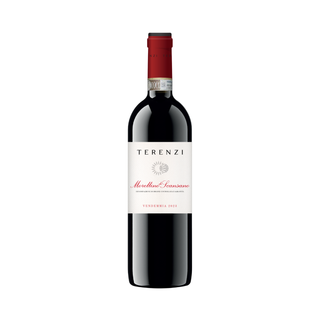
Our recommendation: Terenzi Morellino di Scansano
The producer that best captures the uncompromising quality of 100% Sangiovese is Terenzi, from the Maremma coast of Tuscany. Their Morellino di Scansano is pure Sangiovese, and it became one of our best-selling reds almost immediately after launch.

Committing to 100% means accepting the full exposure of the vintage, season after season. Terenzi made that choice deliberately, aiming to bring out what Sangiovese calls "its true soul": elegance, precision, and genuine terroir expression. The commitment has been recognised: Terenzi is now among the most talked-about producers in the Morellino DOCG. Their single-vineyard cuvee Madrechiesa is a regular Tre Bicchieri winner in Gambero Rosso.
Start with the Morellino as your introduction to the grape. Ready to go deeper? Madrechiesa is waiting. Browse all Sangiovese wines here.
The Tuscan ending: dipping cantucci into Vin Santo
In Tuscany, the meal doesn't end with coffee. It ends with a small glass of Vin Santo, a sweet amber wine made from dried Trebbiano and Malvasia grapes, and a few cantucci (the twice-baked almond biscotti from Prato). You dip the hard biscuit into the wine, let it soften for a moment, and eat it. When this appears after dinner, it is Tuscany's signal: "stay a little longer."
In Japan, both biscotti and dessert wines are known in isolation, but the ritual of dipping, and the cultural meaning of that gesture as hospitality, has not quite crossed over yet. Finishing an evening of Sangiovese with Vin Santo and cantucci from the same region is, for me, one of the most complete ways to experience Tuscany through the glass.
FAQ
Q. Is Sangiovese approachable for beginners?
A. Yes. Softer expressions like Morellino di Scansano have gentle tannins and ripe fruit, making them an excellent entry point for anyone new to Italian reds.
Q. Why is Sangiovese often blended?
A. Its large yields and vintage sensitivity make it tricky. A little of another variety adds stability and fills gaps the grape can leave in difficult years. Achieving consistent quality at 100% demands exceptional vineyard and cellar discipline, which is why Terenzi's Morellino stands out.
Q. What is the relationship between Sangiovese and Chianti?
A. Chianti is the wine; Sangiovese is the grape behind it. "Sangiovese equals the star of Chianti" is the simplest way to remember the connection.
Q. What temperature should I serve it at?
A. 16 to 18 degrees Celsius. Lighter styles benefit from a slight chill, which brightens the fruit.
Q. Is Sangiovese the same grape as Montepulciano?
A. They are often confused but they are completely different varieties. The Montepulciano in "Montepulciano d'Abruzzo" is a distinct native grape from Abruzzo. "Vino Nobile di Montepulciano," on the other hand, is a wine made in the Tuscan town of Montepulciano and is principally Sangiovese, there called Prugnolo Gentile. The word Montepulciano appears in both contexts for different reasons: one is a grape name, the other is a place name. This traps even experienced wine drinkers.
Q. How much does Sangiovese cost to try?
A. In Japan, serious Sangiovese starts from around ¥3,000. Entry-level Chianti and Morellino di Scansano typically fall in the ¥3,000 to ¥4,500 range. Premium expressions like Brunello di Montalcino run from ¥8,000 to ¥20,000 or more. We carry a 100% Sangiovese Morellino di Scansano at ¥3,850 (tax included).


Comments (0)
There are no comments for this article. Be the first one to leave a message!