

What Is Brunello di Montalcino?
Brunello di Montalcino is a 100% Sangiovese DOCG wine produced in the hilltop town of Montalcino in Tuscany's Siena province. Recognized as one of Italy's very first DOCGs in 1980, it sits at the absolute pinnacle of Italian wine. "Brunello" is the local name for Sangiovese — derived from bruno (brown), a reference to the grape's deep color — making the full name simply "Montalcino's Sangiovese."
By law, standard Brunello must age a minimum of five years before release (including two in oak and four months in bottle); Riserva requires six years or more. It is a wine built uncompromisingly for long aging.
The Key Misconception: How Is It Different from Chianti?
"It's a Tuscan red, so it must be in the same family as Chianti" — a reasonable assumption, but wrong in important ways. While both use Sangiovese, Chianti allows blending with other varieties; Brunello is 100% Sangiovese. Its aging requirement is roughly five times longer than standard Chianti. Where a young Chianti is about fresh fruit, Brunello adds time itself as an ingredient — a fundamentally different wine.
Many also assume that a high price tag means a difficult wine. Paired with the right food and served at the right temperature, Brunello is surprisingly food-friendly.
Flavor Profile
| Characteristic | Profile |
|---|---|
| Body | Full-bodied, substantial weight |
| Acidity | High (vivid acidity from Montalcino's limestone soils) |
| Tannins | High (quite firm in youth, silkening with age) |
| Aromas | Cherry, plum, rose, leather, tobacco, spice; with age: truffle, dried herbs, worn leather |
| Alcohol | 13–14.5% |
| Serving temperature | 16–18°C (61–64°F) |
Montalcino's Geography and Styles
Montalcino sits at roughly 564 m elevation in Tuscany, where the Tyrrhenian Sea and the Apennine Mountains pull the climate in two directions — creating the tension of acidity and structure that makes this wine irreproducible elsewhere. Vineyards on the cooler northern slopes tend toward elegance and pronounced acidity; the warmer southern slopes produce rounder, more generous fruit.
For those new to Brunello, Rosso di Montalcino is the natural starting point. Made from the same vineyards and producers, it is released after just one year of aging (minimum six months in oak), carries noticeably more freshness, and costs 20–30% less. Think of it as the same terroir, with less waiting.
Food Pairing and Serving Tips
Brunello's high acidity and tannins soften beautifully against fat and richness. In a Japanese context, the best pairings are beef braised in red wine, sukiyaki, rich duck preparations, and wagyu over charcoal. Sukiyaki — with its sweet-savory soy and sugar base — turns out to be a surprisingly excellent match for Brunello's fruit.
Decanting for 45 minutes to an hour is strongly recommended, especially for younger vintages where tannins can still feel quite firm. Opt for a wide-bowled Burgundy glass over a Bordeaux glass — the larger surface helps the aromatics open up.
Federico's Recommendation
I'll be honest: Brunello di Montalcino is not yet in Swirl's portfolio. The minimum price point exceeds ¥10,000 a bottle, and the logistics and inventory requirements are significant.
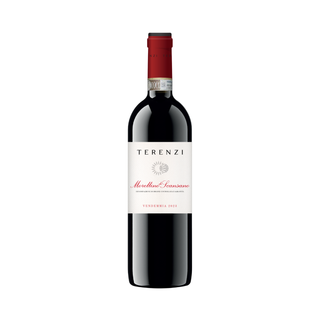
For those who want to experience the Tuscan Sangiovese character — that signature acidity, structure, and spice — without the price of Brunello, the wine I recommend is Morellino di Scansano (Terenzi). Same Tuscan region, same Sangiovese-dominant blend, similar bright acidity and spice, at ¥3,850. It is an ideal bridge wine into the world of great Tuscan reds.
How to Choose and Serve
When selecting a Brunello, vintage quality matters, but so does the producer's philosophy. Traditional producers (Biondi-Santi, Case Basse) make wines of extraordinary longevity that open slowly. Modern-style producers (Banfi, Caparzo) tend to be more approachable in youth.
Standard Brunello typically reaches its drinking window 8–15 years after the vintage. Riserva wines can have 20–30+ years of potential. If you open one young, decant it — no shortcuts.
Frequently Asked Questions
Why is Brunello so expensive?
Three factors combine: a mandatory minimum five-year aging period (capital tied up for years), strict yield limits (750 kg per 1,000 m²), and a geographically constrained production zone. Limited supply against strong global demand keeps prices elevated.
Are Brunello and Rosso di Montalcino made from the same grapes?
Yes. Both are Sangiovese from the same zone. Rosso is often made from younger vines or barrels not selected for Brunello, aged for one year, and meant to be drunk younger and fresher.
Which vintages should I look for?
2010, 2015, and 2016 are particularly celebrated. The 2010 is opening beautifully now. The 2015 and 2016 have extraordinary potential and reward further patience.
When was Brunello created?
Clemente Santi first bottled Montalcino Sangiovese on its own in 1865 and called it "Brunello." His grandson Ferruccio Biondi-Santi released the first commercial Brunello in 1888, isolated the Sangiovese Grosso clone BBS11, and established the foundations of the appellation. Brunello received DOC status in 1967 and became one of Italy's very first DOCGs in 1980.
What foods don't work with Brunello?
Delicate white fish and dashi-forward Japanese dishes struggle against Brunello's tannins and acidity — the wine overwhelms what the food is doing. Choose a dry white for those moments.


Comments (0)
There are no comments for this article. Be the first one to leave a message!