

What Is Pignatello (Perricone)?
Pignatello, also known as Perricone, is one of Sicily's oldest indigenous red grape varieties, originating in the Trapani province of western Sicily. The name Pignatello derives from the Sicilian word pignatidare — the red clay soil found around Trapani and Marsala that was traditionally used to make terracotta cooking pots. In other words, the name literally means "the grape born from clay pot soil." When I share this at Tokyo tastings, the story changes the way people hold the glass.
The Most Common Misconception: The Grape That Made Marsala Is Now a Dry Red
Pignatello is virtually unknown in Japan, yet it has centuries of history on the Sicilian table. What most people do not know is that Pignatello (Perricone) was once the primary grape in Marsala Rubino — the rare red variant of Sicily's most famous fortified wine. Most Japanese wine lovers know Marsala as the amber-coloured fortified wine used in chicken Marsala, but Marsala actually comes in a red (Rubino) version too. In the 18th and 19th centuries in western Sicily, Perricone was blended with Catarratto Bianco and Inzolia to produce a Port-like sweet red fortified wine exported across Europe and beyond. At its peak, Perricone covered around 34,000 hectares in western Sicily alone, underpinning the regional economy. The phylloxera epidemic of the late 19th century devastated those vineyards, and the variety nearly disappeared from memory. Today it is being revived by the next generation of Sicilian winemakers — bottled as a fresh, dry varietal red.
Flavour Profile
| Characteristic | Profile |
|---|---|
| Body | Medium (light on its feet, easy to drink) |
| Acidity | Moderately high (lively, true to indigenous Sicilian character) |
| Tannins | Gentle to medium |
| Aromas | Red fruit (cherry, raspberry), spice, earthy undertones |
| Serving temperature | 14-16°C (or slightly cooler in summer) |
Unlike Nero d'Avola, which tends toward richness and depth, Pignatello leads with fresh red fruit and a spicy lift. Tannins are restrained so it never overshadows the food. Among Sicilian reds, it is probably the most versatile everyday companion at the table.
Styles by Region
| Region | Style | Character |
|---|---|---|
| Western Sicily (Terre Siciliane IGP) | Single-varietal, dry | Cherry, spice, mineral freshness. Accessible medium-bodied red |
| Sicily DOC (blended) | Supporting grape | Adds colour and fresh fruit lift to blends with Nero d'Avola |
The hidden connection between Pignatello and Marsala. Most people think of Marsala as a golden-amber fortified wine used for cooking or as an aperitif — but Marsala Rubino (Red Marsala) is a distinct category that very few know about outside Sicily. In the 18th and 19th centuries in the Trapani-Marsala area of western Sicily, Perricone (Pignatello) was blended with Catarratto Bianco and Inzolia to create a Port-style sweet red exported across Britain and continental Europe. Perricone covered roughly 34,000 hectares in western Sicily at its peak. The phylloxera epidemic of the late 19th century wiped it out almost entirely. Knowing this history as you pour a glass of dry Pignatello today gives the wine a completely different kind of weight.
Enjoying Pignatello in Japan
Pignatello fits the Japanese table better than most people expect. Pairing suggestions:
- Yakitori and charcoal-grilled meats: the smoky, spicy notes on the grape harmonise with the char
- Wagyu beef (lean cuts): restrained tannins let the umami of the meat carry through
- Gyoza and mapo tofu: served slightly cool (around 14°C), it cuts through the richness of Chinese oil-based dishes
- Tomato-based braises: the grape's acidity lifts the sweetness of slow-cooked tomato
The ideal window is 14-16°C. In summer, a short spell in the refrigerator brings out the freshness. One bottle shared over a family dinner disappears without effort.
Federico's Picks
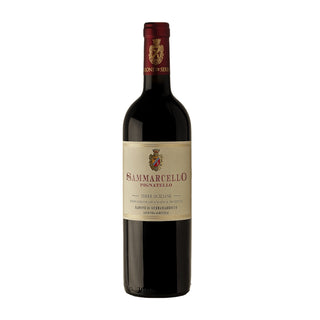
The Pignatello I reach for most often at Tokyo tastings is Serramarrocco's San Marcello Pignatello — fresh cherry, red spice, and clean acidity that makes it a natural everyday red. For an evening when you want more complexity from the bottle, the Barone di Serramarrocco Pignatello 2019 brings richer, more age-developed character. Both capture the red clay soil of western Sicily in a way that is both grounded and vibrant. Internal links: San Marcello Pignatello / Barone di Serramarrocco Pignatello 2019
How to Choose, Serve, and Compare
Choosing Pignatello: look for Perricone or Pignatello on the label, most often under Terre Siciliane IGP. Give it 30-60 minutes of air after opening; the fruit blooms with a little oxygen. Similar grapes: within the Sicilian red family, Nero d'Avola is richer and fuller; for a northern Italian comparison, Freisa (Piedmont) shares the fresh, spicy acidity.
Frequently Asked Questions
Q. Are Pignatello and Perricone the same grape?
A. Yes, they are the same variety. Perricone is the official Italian name used nationwide; Pignatello is the regional synonym used in western Sicily, particularly around Trapani and Marsala.
Q. What is the connection to Marsala wine?
A. Perricone was historically the main red grape in Marsala Rubino, a Port-like red fortified wine produced in western Sicily in the 18th and 19th centuries. The variety covered 34,000 hectares at its peak before phylloxera wiped it out. It is now revived as a dry table wine.
Q. What is the most common mistake?
A. Expecting a deep, powerful red and finding Pignatello lighter in colour and body. This grape's strength is freshness and spice, not concentration — approach it the way you would a quality light-to-medium red rather than a full-bodied Sicilian like Nero d'Avola.
Q. What is the ideal serving temperature?
A. 14-16°C. Take it out of the refrigerator 15-20 minutes before serving, or in summer serve it slightly cooler for extra freshness.
Q. Does it age well?
A. The San Marcello Pignatello is best enjoyed young, within 2-4 years. The Barone di Serramarrocco Pignatello 2019 has more structure and can continue to develop over several more years.


Comments (0)
There are no comments for this article. Be the first one to leave a message!